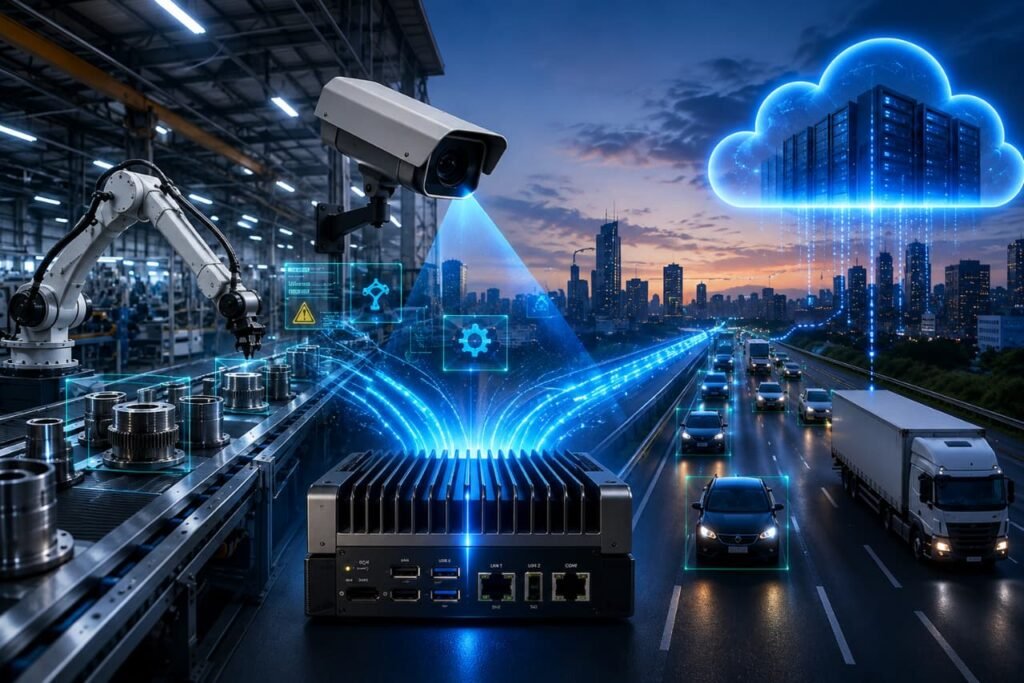
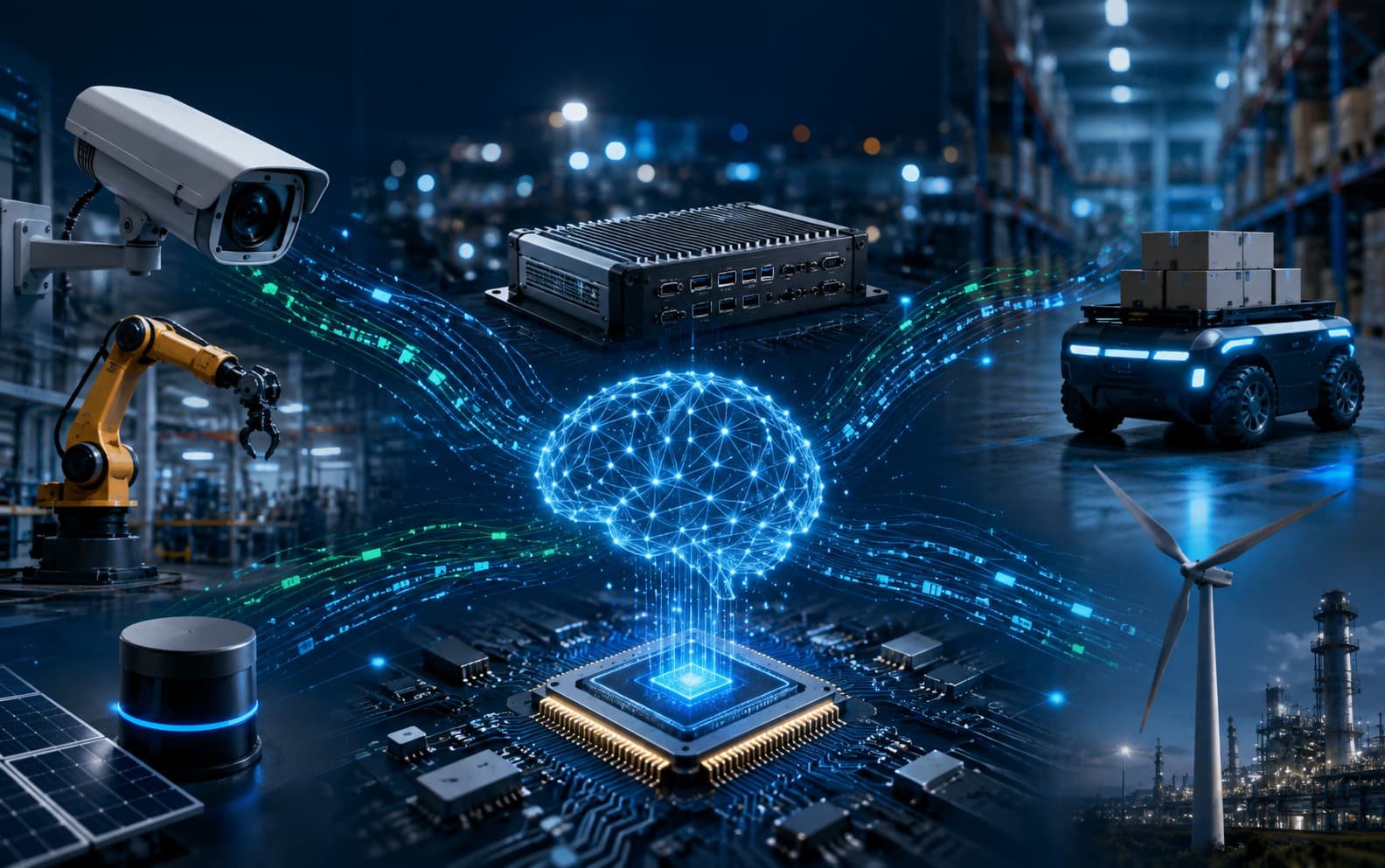
For the last decade, the standard architecture for artificial intelligence has been entirely cloud- centric. Devices collected raw data, pushed it to a server farm, and waited for an answer. But as we deploy more sensors, cameras, and autonomous systems into the physical world, the cloud-only model is hitting a wall.
The industry is currently undergoing a massive architectural shift to Edge AI, moving the machine learning models out of the data center and directly onto the devices generating the data.
This is not merely an emerging software trend, it is a necessary infrastructure redesign dictated by
latency, bandwidth, and power.
Why the Shift is Happening?
- Latency (The Speed Limit): Cloud computing relies on transmitting data to a remote server, processing it, and waiting for the response. This inherent network delay is unacceptable for systems that require instantaneous, deterministic reactions.
- Industry Scenario: In automated manufacturing, if a robotic arm detects a human entering its safety zone, it needs to halt in milliseconds. A round-trip to a cloud server takes too long. Edge AI processes the vision data locally, ensuring a real-time safety trigger.
- Bandwidth (The Pipeline is Full): Continuous data transmission requires massive network capacity. As the number of high-fidelity sensors scales, sending everything to the cloud becomes cost-prohibitive, degrades local network performance, and is highly vulnerable to connectivity drops.
- Industry Scenario: An industrial acoustic sensor sampling at 48kHz or a network of 4K security cameras generates massive, continuous payloads. Edge AI solves this by analyzing the heavy video and audio on-site, dropping the raw files, and transmitting only text-based alerts.
-
Privacy and Security: Transmitting raw, unencrypted data over public or wide-area networks exposes sensitive information to interception and cyber threats. Keeping data local inherently reduces the attack surface and ensures compliance with strict data residency laws.
- Industry Scenario: In healthcare facilities or proprietary manufacturing plants, transmitting raw patient video or confidential production footage is a major liability. Edge AI allows the raw video to remain completely on the physical device, transmitting only the final metadata.
To visualize how this fundamentally changes network dependency, consider the diagram below. The legacy cloud model demands a continuous, heavy stream of data to decide. In contrast, the modern edge architecture executes the decision locally, sending only lightweight metadata back to the cloud.
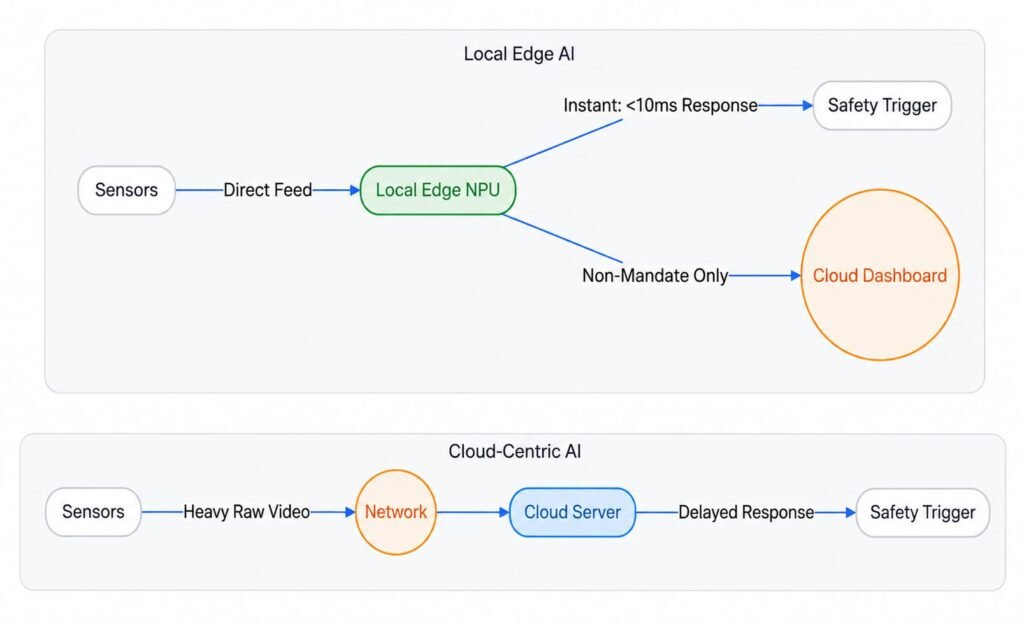
Figure 1: Architectural comparison of Cloud-Centric vs. Local Edge AI data pipelines.
Deconstructing the Edge Architecture
“The Edge” is not a single type of device. It represents a spectrum of hardware, scaling from microscopic sensors to heavy on-premises servers. As engineers, we categorize the edge based on the available compute and power budget.
The following breakdown illustrates this hardware spectrum, ranging from milliwatt microcontrollers handling basic anomalies to multi-watt servers running complex vision pipelines.
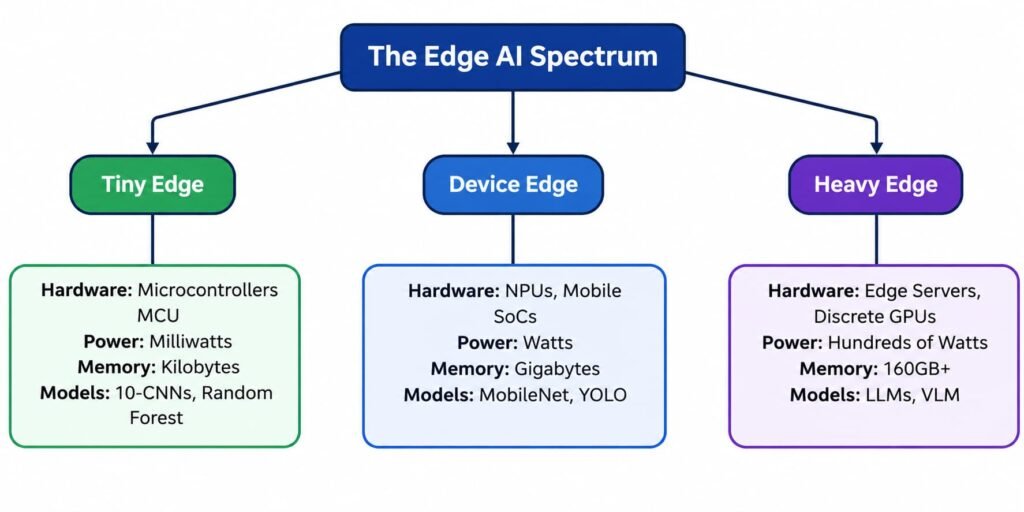
Figure 2: The Edge AI hardware spectrum and corresponding model capabilities.
At the Tiny Edge, we work with ultra-low-power silicon—such as ARM Cortex-M microcontrollers or RISC-V chips—running on coin-cell batteries to analyze basic telemetry like vibration data. Moving up to the Device Edge, we rely on mobile SoCs and Neural Processing Units (NPUs) to handle localized tasks, such as running lightweight object detection directly within a smart camera module. Finally, at the Heavy Edge, we deploy fan-cooled industrial PCs equipped with discrete GPUs capable of parsing dense, multi-camera RTSP video streams simultaneously.
Beyond the Theory: Industrial Applications
While the architectural shift makes sense on paper, its true value is realized on the factory floor. By moving compute to the edge, industries are unlocking capabilities that were previously impossible due to cloud dependencies.
- Predictive Maintenance (Tiny Edge): Instead of sending continuous audio streams of a factory motor to the cloud, acoustic anomaly models run directly on low-power DSPs attached to the machinery. They listen to the specific frequency of a failing bearing and only transmit an alert when maintenance is required.
- High-Speed Quality Inspection (Device Edge): On a fast-moving assembly line, sending high-resolution images of every product to a remote server introduces too much latency. Edge NPUs processes these images locally in milliseconds, instantly triggering a robotic arm to discard defective units before they move down the line.
- Autonomous Guided Vehicles / AGVs (Heavy Edge): Warehouse robots require continuous spatial awareness to navigate Relying on a Wi-Fi connection to a central server for pathfinding is a recipe for collisions. Heavy Edge compute on the robot processes LiDAR and vision data locally, ensuring autonomous, zero-latency navigation.
The Engineering Realities (The Hard Part)
In theory, running a model on a sensor is great. In reality, it is a brutal engineering balancing act. When you build for the edge, you hit several physical realities:
- Severe Memory Constraints: A standard PyTorch computer vision model might require 2GB of RAM. A smart camera might only give you 500MB, and a microcontroller might give you 250 kilobytes. We have to aggressively compress models, often banning dynamic memory allocation entirely in favor of static tensor arenas.
- The Quantization Tax: To make models run fast on edge silicon, we have to quantize them—converting highly accurate 32-bit floating-point math (FP32) into 8-bit integers (INT8). This makes the model lighter and faster, but if you don’t engineer it correctly, the accuracy of your model will collapse.
- Thermal Throttling: Running complex matrix multiplication generates heat. If you deploy an object detection model onto a small, fan-less gateway in a hot factory, the chip will overheat and throttle its own clock speed. Suddenly, your 30 FPS pipeline drops to 5
Looking Ahead
Edge AI is not replacing the cloud; it is filtering the noise. By pushing the “brain” closer to the sensors, we allow edge devices to make fast, tactical decisions locally, while the cloud handles the heavy, strategic analytics.
Getting these models to actually fit on constrained hardware requires an entirely different set of software engineering skills.
In my next post, we will dive deeper into the software layer. We will look at how to take a standard machine learning model, compile it down using tools like TensorRT or ONNX, and squeeze it onto a piece of edge hardware without destroying its accuracy.